Free material order planner
River Rock Calculator
Use this river rock calculator to estimate cubic feet, cubic yards, tons, bag count, coverage, and a simple cost placeholder from length, width, depth, density, and waste. It builds a printable material list for beds, borders, and dry creek bed projects before you order bagged or bulk stone.
Open calculatorEstimateEstimate only; supplier material density, stone size, moisture, edging, and local drainage conditions vary.
Project inputs
Recommended order
Order 1.25 cu yd in bulk
Bulk is about $263.75 less with the entered delivery charge. Estimated delivered total: $156.25. The bagged alternative is $420.00.
Project quantity: 1.07 cubic yards of river rock
Smart Buy Planner
Bags or bulk?
1.25 cu yd at $65.00/yd + $75.00 delivery
60 50-lb bags at $7.00 each
Bulk is about $263.75 less with the entered delivery charge.
Cost comparison only. Local prices, taxes, access, pickup capacity, product grade, and delivery terms vary.
Order and transport check
Supplier basis1.07 cu yd · 1.5 tons
Bagged option60 50-lb bags; compare the actual package label
Pickup or deliveryConfirm vehicle payload, supplier minimums, moisture, and delivery access before ordering.
Printable material list
Estimate- River rock1.07 cu yd8% waste included
- Typical bulk cost$54–$118regional planning range; edit the price field for a local rate
- Delivery vs DIY haulAbout 3 pickup loadsroughly 10 wheelbarrow loads to move it; heavy material, so confirm your truck's payload before hauling
- River rock by weight1.5 tons1.4 tons/cu yd density
- Bagged river rock60 50-lb bagsround up before buying
- Cost at your price$69.55at $65/cu yd — edit the price field
- Coverage at 2 inches172.8 sq ftspread thinner or deeper to change coverage
Estimate only. Rounded river rock packs differently than crushed stone, and supplier density and stone size vary.
EstimateEstimate only; supplier material density, stone size, moisture, edging, and local drainage conditions vary.
Assumptions
- Default river rock density is about 1.40 tons per cubic yard.
- Cubic yards equal cubic feet divided by 27.
- Bag count uses your selected bag weight and rounds up to whole bags.
- Cost is a placeholder using your entered bulk price, not a quote.
Calculation details
- Area = length x width.
- Cubic feet = area x depth in feet.
- Cubic yards = cubic feet / 27.
- Tons = cubic yards x density.
Calculator guideDepth, measuring, formulas, and common mistakes7 practical sections for this material
What this river rock calculator does
River rock is sold a few ways. You might see it bagged by the pound, bulk by the cubic yard, or on delivery tickets by the ton. This calculator keeps those units aligned. Enter the bed footprint, depth, density, bag weight, and waste, and it returns cubic feet, cubic yards, tons, bag count, coverage, and a simple bulk cost placeholder for planning.
It fits decorative beds, borders, tree rings, dry creek beds, and drainage-look channels where rounded stone is the visible finish. It does not decide whether river rock suits a particular drainage or traffic situation. It turns a measured area into a practical shopping list with every assumption shown so you can sanity-check the numbers.
How deep should river rock be?
River rock stones are rounded and often larger than pea gravel, so a thin layer can look sparse and let fabric or soil show through. Two to three inches is a common planning depth for decorative beds, and larger stone sizes lean toward the deeper end. Dry creek beds are usually deeper in the channel center than along the edges, so estimate those zones separately.
Depth drives the order quantity directly. A 100 square foot bed at 2 inches is about 16.7 cubic feet before waste, and the same bed at 3 inches is 25 cubic feet. When the project sits near a bag or delivery threshold, confirming depth first helps avoid both a shortage and a leftover pile of stone you have to store.
Formula used
The calculator multiplies length by width for square feet, then by depth in feet for cubic feet. Cubic yards equal cubic feet divided by 27. Tons equal cubic yards times the density you enter. Bag count converts tons to pounds, divides by your bag weight, and rounds up. Waste is added on top before the final quantities.
Density is the least universal input. River rock density shifts with stone size, gradation, rounding, moisture, and source. The 1.40 tons per cubic yard default is a planning value, and rounded river stone usually differs from crushed gravel. If a local yard lists a different conversion, type that number into the density field instead.
When river rock is the right stone
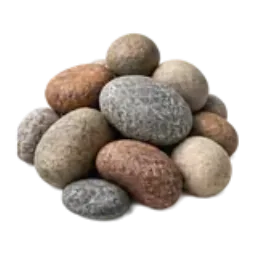
River rock is larger, smooth, rounded stone, commonly one to three inches, chosen where the look and water handling matter more than walking comfort. It works as a low-maintenance ground cover in beds and tree rings, as the lining of a dry creek bed or drainage swale, and as a splash zone under a downspout, where the stone size lets water pass without washing the rock away.
Because the stones are large and uneven, they are awkward to walk on, so a path, patio, or play surface is better sized with the pea gravel calculator and its smaller rounded stone. And when the job is a compacted, load-bearing base rather than a decorative finish, the angular crushed stone calculator is the right tool, since rounded river rock will not knit together under a compactor.
Common mistakes
The most frequent error is treating square feet as cubic feet and skipping depth. Another is confusing tons with cubic yards: a cubic yard is volume, a ton is weight, and the link between them is density, so two suppliers can quote different tonnage for the same bed. Larger river rock also packs loosely, which nudges real-world coverage below tidy table values.
It is easy to forget landscape fabric, edging, and base prep. Those items are not in the stone number but they shape the finished bed. Underestimating dry creek bed depth at the channel center is common too. The printable list gives stone quantities and assumptions, leaving room to add fabric, staples, edging, and tools.
River rock size grades and depth
River rock comes in size grades, and the grade sets how much depth you need to hide the ground. Around three-quarter-inch stone settles into a fairly even layer, so two inches covers most beds. One-to-three-inch and three-to-five-inch stone sits with wide gaps, and a single layer leaves soil showing between the rocks. A rough planning rule is a depth of two to three times the stone diameter, so the largest grade can want four inches or more.
That rule pushes coverage down as the grade climbs. A cubic yard that spreads far in small stone covers much less ground once you order three-to-five-inch rock at the deeper setting it needs. The coverage table assumes one depth, so read it at the depth your grade actually needs, not the shallow end. Setting the depth field to the grade you plan to buy first is the safest way to avoid coming up short on the bigger rock.
Before you order
Take the printed list, bed dimensions, chosen stone size, and site notes to the supplier. Ask whether their density, bag weight, and stone size match the calculator assumptions, because rounded river stone and crushed product behave differently. If the numbers differ, update the density field and recompute rather than guessing at the register from memory.
Keep the disclaimer with the list. It is a planning estimate, and supplier material and local conditions vary. If the project affects drainage flow, slope stability, runoff onto a neighbor, or a structure, get local advice first. Order edging, fabric, and any base material separately, since this estimate covers the decorative stone only.
River rock coverage by depth
| Depth | Coverage per cubic yard | Coverage per ton |
|---|---|---|
| 1 in | 324 sq ft | 231 sq ft |
| 2 in | 162 sq ft | 116 sq ft |
| 3 in | 108 sq ft | 77 sq ft |
| 4 in | 81 sq ft | 58 sq ft |
Based on 1 cubic yard = 27 cubic feet and a planning density of 1.4 tons per cubic yard. Rounded river stone differs from crushed, and supplier density varies.
River Rock Calculator FAQ
How do I calculate river rock needed?
Multiply length by width for square feet, multiply by depth in feet for cubic feet, then divide by 27 for cubic yards. Add a waste factor, then convert to tons or bags using the density and bag weight.
How many square feet does a cubic yard of river rock cover?
One cubic yard is 27 cubic feet. At 2 inches deep it covers about 162 square feet before waste, and at 3 inches deep it covers about 108 square feet before waste.
How many tons are in a cubic yard of river rock?
A common planning value is about 1.4 tons per cubic yard, but density varies with stone size and source. Use the supplier conversion when you order by weight.
How deep should a dry creek bed be?
Dry creek beds are usually deeper at the channel center than the edges, so estimate the center and sides separately. A planning estimate is no substitute for local advice when real water flow is involved.
Should I buy river rock in bags or bulk?
Bags suit small beds and tight access. Bulk ordering is usually better for larger beds and dry creek beds, but watch delivery minimums, the dump location, and the labor to move heavy stone.
Does the calculator include landscape fabric?
No. It estimates the decorative stone quantity only. Add landscape fabric, staples, edging, base material, and tools separately based on the actual bed and site conditions.
What size river rock should I use?
It depends on the look and the spot. Three-quarter-inch and one-to-three-inch stone suits beds, borders, and tree rings, where a finer texture reads well up close. Three-to-five-inch stone suits dry creek beds and larger feature areas, where bigger rock holds scale. The choice is mostly look, but the bigger grades need more depth to cover the ground evenly.
Why does larger river rock cover less area per cubic yard?
Coverage depends on stone size, not just depth. Small grades settle into a denser layer and stretch a cubic yard further, while three-to-five-inch rock leaves wide gaps and wants a deeper setting to hide the soil. Both effects work the same way, so a yard of big stone covers far less ground. Match the depth field to your grade before trusting the coverage figure.
How do I estimate river rock for a round bed or tree ring?
River rock often rings a feature, so for a border around a pond, fountain, or tree, choose ring and enter the outer diameter plus the open center. For a round island bed, use circle and its diameter. The calculator sizes that footprint and converts it to cubic yards, tons, and bags at your depth and density.
How this estimate is built
Formula
- Area = length x width.
- Cubic feet = area x depth in feet.
- Cubic yards = cubic feet / 27.
- Tons = cubic yards x density.
Inputs and assumptions
Editable inputs include Area shape, Length, Width, Diameter, Base, Height, Outer diameter, Inner diameter, Depth, Waste, Density, Bag weight, Bulk price, Bag price, Bulk delivery, Bulk minimum. Defaults and calculation assumptions are listed in the Assumptions section and can be replaced with measurements or product-label data.
Sources and testing
Public density, coverage, package, and application references inform the defaults. Automated unit tests cover shared conversions and calculator logic; they do not validate site conditions, supplier labels, or project design.
Limits
Region, moisture, compaction, grading, waste, and supplier specifications can change the amount required. This is a planning estimate, not structural, safety, engineering, or professional construction advice.
Read the calculation methodology and sources and update policy.